
Cashew is the common name of a tropical evergreen tree Anacardium occidentale, in the family Anacardiaceae
Malagasy cashew production is projected to increase slightly in the next five years. By 2026, supply is estimated to reach 7,400 metric tons, a 0.3% year-on-year average growth rate. Since 1966, the production of cashews in Madagascar has grown at a rate of 0.4% year-on-year.

cloves are the aromatic flower buds of a tree in the family Myrtaceae,
Syzygiumaromaticum. Cloves are available throughout the year due to different harvest seasons in different countries.
Cloves are used in the cuisine of Asian, African, and the Near and Middle East countries, lending flavor to meats, curries,
and marinades, as well as fruit such as apples, pears or rhubarb. Cloves may be used to give aromatic and flavor qualities
to hot beverages, often combined with other ingredients such as lemon and sugar.

The black-eyed pea or black-eyed bean is a legume grown around the world for its medium-sized, edible bean.
One 100 g serving of cooked black-eyed peas contains 484 kilojoules (116 kilocalories)
of food energy and is an excellent source of folate and a good source of thiamine, iron,
magnesium, manganese, phosphorus, and zinc.
Organic beans from medagascar adds upto the above benifits.

coffee bean is a seed from the Coffea plant and the source for coffee.
It is the pip inside the red or purple fruit.
The four main coffee types are Arabica, Robusta, Excelsa, and Liberica and all four of them have radically different taste profiles.
The two most economically important varieties of coffee plants are the Arabica and the Robusta; approximately 60% of the coffee produced worldwide is Arabica and ~40% is Robusta. Arabica beans consist of 0.8–1.4% caffeine and Robusta beans consist of 1.7–4.0% caffeine. As coffee is one of the world's most widely consumed beverages, coffee beans are a major cash crop and an important export product.
Known for its consistently rich flavor along with a deep, wine-like acidity and pleasant aroma, Kenyan, ethiopian & medagascar coffee beans have distinctly bright taste with complex tones of fruit and berry. Kenyan coffees have a huge range of flavors and nuances depending on the region, varietal and processing methods used.

Black pepper is the world's most traded spice and is one of the most common spices added to cuisines around the world.
One tablespoon (6 grams) of ground black pepper contains moderate amounts of vitamin K (13% of the daily value or DV), iron (10% DV), and manganese (18% DV), with trace amounts of other essential nutrients, protein, and dietary fibre.
Madagascar black pepper is a highly aromatic and powerful pepper. Its aromas are fresh and reminiscent of tangy fruits but also with gourmet notes of brioche and resin. Slightly spicy, Madagascar black pepper is full of aromas, perfect for your everyday cooking.

The cocoa bean (technically cocoa seed) or simply cocoa also called cacao is the dried and fully fermented seed of Theobroma cacao, the cacao tree, from which cocoa solids (a mixture of nonfat substances) and cocoa butter (the fat) can be extracted.
Medagascar cocoa beans are high in quality of enrich taste.
Cocoa powders, chocolate liquor, and blends of the two are used in bulk to flavour various food products and to provide the flavours in such “chocolate” products as syrups, toppings, chocolate milk, prepared cake mixes, and pharmaceuticals.

Vanilla is from the dried, cured beans or fruit pods of the green-stemmed climbing perennial of the Vanilla species, which is a member of the orchid family.
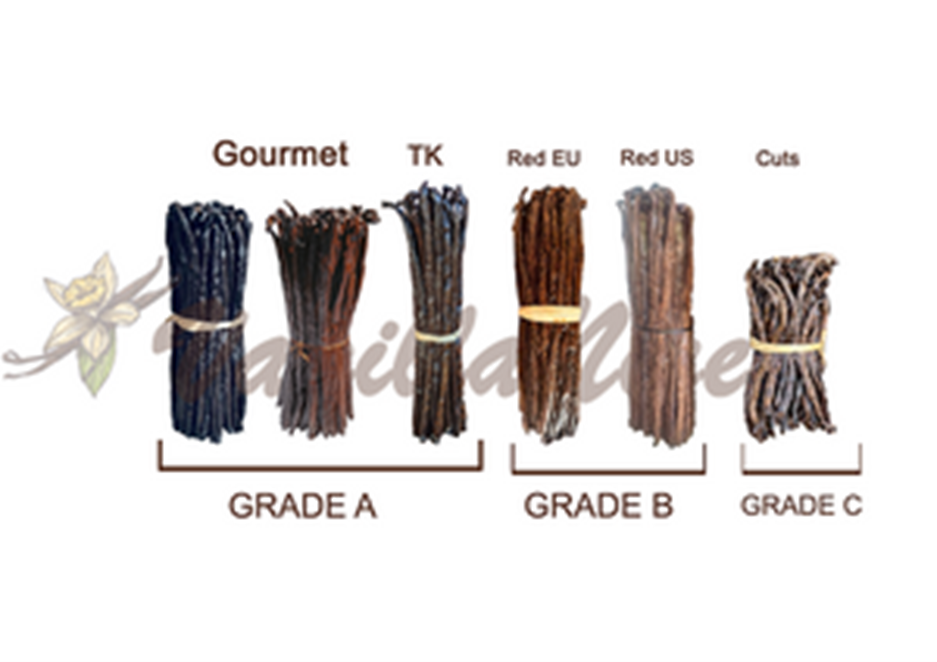
| Grade A / Grade I |
15 cm and longer, 100–120 fruits per pound |
Also called "Gourmet" or "Prime". 30–35% moisture content. |
| Grade B / Grade II |
10–15 cm, 140–160 fruits per pound |
Also called "Extract fruits". 15–25% moisture content. |
| Grade C / Grade III |
Grade C / Grade III |

Turmeric or Curcuma longa ( is a flowering plant in the ginger family Zingiberaceae. It is a perennial, rhizomatous, herbaceous plant native to the Indian subcontinent and Southeast Asia.
Turmeric is one of the key ingredients in many Asian dishes, imparting a mustard-like, earthy aroma and pungent, slightly bitter flavor to foods. It is used mostly in savory dishes.
Turmeric has been used in Asia for centuries and is a major part of Ayurveda, Siddha medicine, traditional Chinese medicine, Unani.
Madagascar and kenyan turmeric has high levels of curcumin percentage.

Belong to the legume family. They are a good source of B vitamins, folate, iron, and potassium. They also contain high levels of protein and fiber.
Lentils are relatively quick and easy to prepare, and their low cost makes them an accessible form of high quality protein for many people around the world.
Lentils are a plentiful source of fiber, folic acid, and potassium. These nutrients all support heart health.
Lentils have high content of antioxidants, including phenolic compounds. These antioxidants play a vital role in neutralizing harmful free radicals in the body and protecting against oxidative stress and chronic diseases.
100 grams (g) of cooked lentils containsTrusted Source:
116 calories (kcal)
9.02 g of protein
0.38 g of fat
20.13 g of carbohydrates, including 7.9 g of fiber and 1.8 g of sugar

An industrial mineral is a rock, a mineral or other naturally occurring material of economic value. An industrial mineral is defined by its physical properties, such as fibrosity, insulation capacity, density, hardness, and so on.
Industrial minerals are also essential to the technologies employed in defense, agriculture, and renewable energy industries.
Industrial minerals serve as asbestos substitutes for insulation and as absorbents for oil and chemical clean-ups.
The most widely used industrial minerals include limestone, clays, sand, gravel, diatomite, kaolin, bentonite, silica, barite, gypsum, potash, pumice, talc,blue labradorite & garnet.

Turmeric or Curcuma longa ( is a flowering plant in the ginger family Zingiberaceae. It is a perennial, rhizomatous, herbaceous plant native to the Indian subcontinent and Southeast Asia.
Turmeric is one of the key ingredients in many Asian dishes, imparting a mustard-like, earthy aroma and pungent, slightly bitter flavor to foods. It is used mostly in savory dishes.
Turmeric has been used in Asia for centuries and is a major part of Ayurveda, Siddha medicine, traditional Chinese medicine, Unani.
Madagascar and kenyan turmeric has high levels of curcumin percentage.

"Exporting meat involves the international trade of various products exclusively of Goat & Lamb."
Meat is a significant commodity globally, fulfilling dietary needs and culinary preferences worldwide. Exporting meat requires adherence to strict regulatory standards, including food safety and hygiene regulations, as well as compliance with import requirements of destination countries.
The process involves sourcing livestock from farms or ranches, processing them in slaughterhouses, and then packaging and storing the meat for transportation. Exporters often utilize refrigerated or frozen storage and shipping methods to maintain the quality and freshness of the meat during transit.
Additionally, exporters must navigate trade agreements, tariffs, and quotas to access international markets. Successful meat export businesses prioritize quality control, animal welfare, and supply chain transparency to meet consumer demand for safe, high-quality meat products across borders.

An industrial mineral is a rock, a mineral or other naturally occurring material of economic value. An industrial mineral is defined by its physical properties, such as fibrosity, insulation capacity, density, hardness, and so on.
Industrial minerals are also essential to the technologies employed in defense, agriculture, and renewable energy industries.
Industrial minerals serve as asbestos substitutes for insulation and as absorbents for oil and chemical clean-ups.
The most widely used industrial minerals include limestone, clays, sand, gravel, diatomite, kaolin, bentonite, silica, barite, gypsum, potash, pumice, talc,blue labradorite & garnet.
Exporting textiles involves the international trade of fabric and textile products from one country to another.
Textiles encompass a wide range of materials, including cotton, wool, silk, synthetic fibers, and blends thereof, which are used in the production of clothing, home furnishings, and industrial applications.
Exporting textiles requires adherence to quality standards, including fabric durability, colorfastness, and compliance with safety regulations. The process involves sourcing raw materials, manufacturing fabrics, and then exporting them to various markets. Exporters often engage in product customization to meet the specific requirements of different regions or clients. Successful textile export businesses focus on factors such as cost competitiveness, design innovation, sustainability, and efficient supply chain management to meet the diverse needs of global consumers and industries.

Herbal cosmetics are natural and free from all the harmful synthetic
chemicals which otherwise may prove to be toxic to the skin. Instead
of traditional synthetic products different plant parts and plant
extracts are used in these products.
Nurture your skin, embrace radiance, and show yourself the care you
deserve with 3AM Skincare – your skin’s BFF. Say HELLO to radiant
glowing skin with vegan skin care products because at 3AM we bring
you only the best.
Discover the perfect balance of nature and science with our clean
beauty and vegan skincare products that are formulated from the
goodness of plant-based ingredients. Bring out your skin’s radiance
with the transformative power of plant-based ingredients combined
with cutting-edge scientific innovations - perfect for healthy skin.
Just like a loyal friend, 3AM’s multifunctional skincare products work
tirelessly to give you vibrant and glowing skin. With its powerful
ingredients and gentle touch, 3AM is always here to support you in
your journey to flawless skin.

Surgical equipment and accessories are essential tools that can be found in all hospitals and health clinics.
A surgical instrument is a medical device for performing specific actions or carrying out desired effects during a surgery or operation, such as modifying biological tissue, or to provide access for viewing it. Over time, many different kinds of surgical instruments and tools have been invented. Some surgical instruments are designed for general use in all sorts of surgeries, while others are designed for only certain specialties or specific procedures.
Classification of surgical instruments helps surgeons to understand the functions and purposes of the instruments. With the goal of optimizing surgical results and performing more difficult operations, more instruments continue to be invented in the modern era.
Medical equipment is an article, instrument, apparatus or machine that is used in the prevention, diagnosis or treatment of illness or disease, or for detecting, measuring, restoring, correcting or modifying the structure or function of the body for some health purpose.

Cashew is the common name of a tropical evergreen tree Anacardium occidentale, in the family Anacardiaceae
Malagasy cashew production is projected to increase slightly in the next five years. By 2026, supply is estimated to reach 7,400 metric tons, a 0.3% year-on-year average growth rate. Since 1966, the production of cashews in Madagascar has grown at a rate of 0.4% year-on-year.

Exporting flowers involves the international trade of floral products from one country to another. Flowers are cultivated for various purposes, including decorative, ornamental, and medicinal uses. Exporting flowers often requires careful handling to maintain their freshness and quality during transportation.
This process involves harvesting, sorting, packaging, and refrigeration to preserve the flowers' beauty and longevity. Exporters must adhere to phytosanitary regulations and customs requirements of both the exporting and importing countries.
The global flower market is dynamic, with demand influenced by factors such as seasonal variations, cultural traditions, and special occasions like weddings and festivals. Successful flower exporting relies on efficient logistics, market research, and understanding of consumer preferences to meet demand and ensure customer satisfaction worldwide.
